
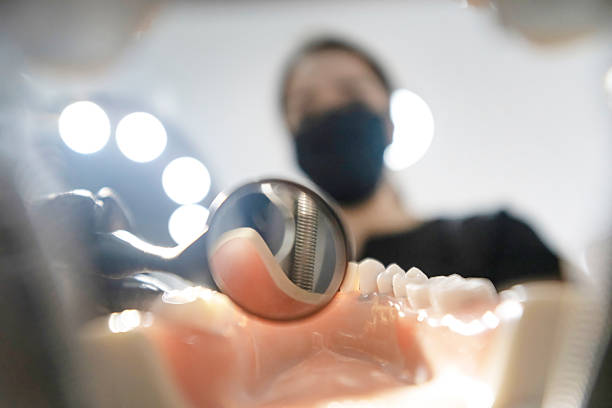
A dental implant can replace a tooth anywhere in the mouth, but the planning priorities are not the same everywhere. A front tooth implant has to look right every time you smile or talk. A molar dental implant has a different job: it has to hold up under heavy, repeated chewing, so it’s planned primarily around load-bearing function rather than appearance.
Back teeth also differ from front teeth in practical ways. Molars have wider crowns, larger chewing surfaces, different surrounding bone anatomy, and different spacing requirements. None of this means a molar dental implant in Asheville, NC is harder or easier than a front tooth implant. It simply means the two are planned around different priorities.
If you’re researching dental implants in Asheville, NC to replace a missing back tooth, this guide covers how chewing force, bone support, and crown design shape a tooth implant in Asheville, NC. Whether you’re working with an implant dentist in Asheville, NC or looking into dental implants in Clyde, NC, understanding these differences can help you know what to expect.
Front tooth implants are planned around the esthetic zone. Gum symmetry, emergence profile, and how the crown looks when you smile all carry real weight. A molar dental implant is planned primarily around function: chewing force, crown width, bone support, posterior anatomy, and how load gets distributed when you bite down.
A front tooth implant leans on esthetics. A back tooth implant, or posterior dental implant, leans on biomechanics instead. That’s the core distinction that shapes dental implant planning for patients with dental implants in Asheville considering a molar replacement.
Molars crush and grind food, so they receive substantial vertical and lateral forces every time you chew. Molar bite force affects how the implant is positioned, how the crown is shaped, and how the bite is planned around it.
Chewing load affects implant stability, which affects crown design, which affects how your bite is planned from the start. Because posterior implant load is real and repetitive, dental implant biomechanics in the back of the mouth get more attention during planning than they typically do for a front tooth.
A molar implant crown has a much larger chewing table than a front tooth crown. This wider surface needs to work with the implant underneath it, not against it, so forces are distributed the way they would be for a natural molar.
Crown dimensions, the occlusal table, and the crown-to-implant relationship all factor into planning. A crown wider than what the implant can properly support may not distribute chewing pressure evenly, which is why crown width for a dental implant and implant selection get planned together rather than separately, especially for a posterior implant crown carrying daily chewing load.
Posterior implants have to withstand repetitive functional load every day, for years. That means planning has to account for vertical forces from straight-down biting, lateral forces from side-to-side chewing motion, how the tooth contacts its neighbors and opposing teeth, and whether the patient shows signs of bruxism, or grinding and clenching. Crown design plays into this too, since a molar crown has to hold up under the same repetitive load the implant itself experiences.
This is different from a general discussion of how bite forces affect dental implants, which applies to implants throughout the mouth. The focus here is specifically on why a posterior location changes how that planning happens.
Before placing a molar implant, a dentist looks closely at how the teeth contact each other, where the opposing tooth sits, how much space the missing tooth left behind, and whether there are signs of grinding or clenching. This dental implant bite and implant occlusion evaluation shapes the entire treatment plan, from implant position to crown design. Molar implant planning that skips this step risks a crown that doesn’t sit correctly in the bite.
Bruxism, or grinding and clenching, can increase the forces placed on a posterior restoration, sometimes leading to implant overload if left unaddressed. This doesn’t rule out a molar implant, but it’s a factor your dentist will weigh when planning implant position, crown material, and bite adjustments, since untreated grinding can affect dental implants long after they’re placed.
Molar sites often need a dental implant diameter capable of supporting a broad crown and handling posterior chewing forces. That said, implant size selection still comes down to each patient’s individual bone anatomy. A wider implant isn’t automatically the better choice for dental implant placement. The right diameter for posterior implant planning depends on what the bone at that specific site can actually support.
If an implant is positioned poorly relative to where the final crown needs to sit, the restoration can end up with unfavorable contours or forces that land off-axis. Implant position affects where the crown’s center sits, which in turn affects implant load distribution and how bite forces travel through the whole restoration.
This is one reason implant positioning matters just as much for long-term function as it does for appearance, even in a spot nobody else can see.
Implant diameter is determined by ridge width, the surrounding bone, the position of neighboring teeth, general anatomy, and what the final restoration needs to look and function like. There’s no universal ideal size for a molar implant. The right diameter is the one that fits the bone that’s actually there.
This practice’s guide on how implant size and diameter are determined goes deeper into how these decisions get made.
Planning a posterior implant means looking at two separate things: how much bone is present, and how dense or strong that bone actually is. A site can have plenty of height and width and still present challenges for dental implant stability if the bone quality isn’t strong enough to fully support the implant.
Bone density, not just bone volume, plays a direct role in dental implant success, and back-tooth sites are evaluated with both factors in mind to give a molar implant the bone support it needs to function under daily chewing load.
Upper back teeth sit close to the maxillary sinus. Once upper molars are lost, bone height in that area can decrease over time, and sinus anatomy can sometimes limit how long an implant can be at that site.
Some cases benefit from discussing when a bone graft supports a dental implant before moving forward with an upper molar implant, and grafting in Asheville, NC is something your dentist can walk you through if your case calls for it.
Lower molar planning requires awareness of the inferior alveolar nerve and the amount of bone height available above it. Because dental implant anatomy in this area is close to a major nerve, imaging and careful implant planning matter more here than in some other parts of the mouth.
Planning also looks different depending on whether the implant is going into the upper or lower jaw, since bone anatomy and density commonly differ between the two.
A common question is simple: it’s in the back, so why replace it? A missing molar or missing back tooth doesn’t show when you smile, but it can still affect chewing efficiency, cause neighboring or opposing teeth to shift, change your bite over time, and lead to bone remodeling at the site.
Not every missing molar needs to be replaced. The right decision depends on your bite, your other teeth, and your overall oral health, and it’s worth discussing tooth replacement in Asheville, NC with a dentist rather than assuming a back-tooth gap doesn’t matter. According to the American Dental Association, remaining teeth may shift, and bone loss can occur around a missing tooth.
When a molar space stays open, the teeth on either side can gradually drift toward the gap. This is called mesial or distal drifting, and it can lead to bite changes, cleaning difficulties, and less space available for a future restoration.
The tooth that used to bite against the missing molar can also shift, in a process called supraeruption, where it gradually moves into the open space over time. How much this happens, and how quickly, varies from patient to patient.
Bone needs functional stimulation to maintain its shape and density. Once a molar is lost, the alveolar bone in that area no longer receives that stimulation and can begin to shrink. Waiting too long after tooth loss can complicate later treatment, which is covered in more detail in this practice’s guide on dental implants after tooth loss.
Once the surgical foundation is in place, attention shifts to the restorative side. A molar implant crown needs the right anatomy, controlled contact with opposing teeth, accessible spaces for daily hygiene, and contours that work with the surrounding gum tissue rather than against it. This kind of dental implant restoration planning is part of every implant restoration in Asheville, NC that this practice designs.
This restorative planning connects directly to how implant crowns attach to the abutment and screw beneath them.
The cusps and grooves on a molar crown chewing surface are shaped to work with the opposing teeth, distributing force the way a natural molar would. This isn’t just about matching the size of a natural tooth. It’s about making sure dental implant occlusion, or how the implant crown bite meets the opposing teeth, handles pressure without concentrating it in one spot.
A crown that’s too wide or bulky can create forces that don’t distribute evenly, trap food in places that are hard to clean, and complicate daily hygiene. Crown contour has a direct relationship with gum health, which is one more reason molar crown design gets careful attention rather than a one-size-fits-all approach.
A single tooth dental implant replaces a missing molar on its own, without requiring crowns on the neighboring teeth just to hold it in place. A traditional bridge works differently, using the teeth on either side of the gap for support.
Neither option is universally better. The right choice depends on the condition of the neighboring teeth, the patient’s bone, and personal treatment goals for tooth replacement in Asheville, NC. This practice has a full comparison of dental implants and bridges if you want to weigh the two options in more depth.
Three-dimensional imaging gives a dentist a much clearer picture of ridge dimensions, sinus anatomy, nerve location, neighboring tooth roots, implant position, and restorative space for the final crown. This kind of dental implant planning in Asheville helps avoid surprises once treatment is underway, and it’s a standard part of the dental implant process in Asheville, NC, and the dental implant evaluation that comes before it. This practice’s article on 3D digital imaging for dental implants covers the process in more detail.
Imaging lets a dentist visualize exactly where the maxillary sinus or mandibular nerve sits relative to the planned implant site. This reinforces the anatomical considerations covered earlier in this guide, giving a clearer, three-dimensional view rather than relying on a flat X-ray alone.
Good implant placement planning starts with the final tooth in mind, not simply wherever bone happens to be available. Working backward from the ideal crown position helps ensure the finished restoration functions and looks the way it should, which ties directly into the importance of implant positioning discussed earlier.
Healing time depends on several factors working together: bone quality, implant stability at placement, whether grafting was needed, the specific location, general health factors, and the loading plan your dentist chooses. Molars don’t universally heal slower than front teeth. Dental implant healing is individual, not fixed by location, and it’s part of what your dentist reviews during the dental implant process in Asheville, NC.
Bone density and anatomy commonly differ between the upper and lower back jaw, which is one reason healing timelines can vary from patient to patient and site to site. This connects to the bone density and upper-versus-lower jaw differences covered earlier in this guide. Absolute statements about which jaw heals faster aren’t accurate, since individual anatomy varies.
Depending on the case, a dentist may wait for sufficient osseointegration before placing the definitive crown. This staged approach protects the long-term stability of the restoration. The osseointegration process is what allows the implant to fuse securely with the surrounding bone before it takes on full chewing load.
When more than one back tooth is missing, there are a few possible paths forward for tooth replacement in Asheville, NC: individual implants placed at each site, an implant-supported bridge, or other restorative options depending on anatomy and how many teeth need replacing. Multiple missing teeth don’t automatically call for the same solution in every patient.
Individual implants replace each missing tooth on its own. An implant-supported bridge uses fewer implants to support multiple replacement teeth. Neither approach comes with a fixed recommended number of implants. That decision depends entirely on your bone, your bite, and your overall treatment goals, and it’s a conversation best had directly with your dentist.
Yes. Implants are commonly used to replace molars when a patient’s anatomy, bone support, general health, and restorative needs are appropriate for the procedure.
Yes, in terms of planning priorities. A molar implant is planned primarily around load and chewing function, while a front tooth implant carries greater esthetic and soft-tissue demands. Both still require adequate bone support, accurate placement, and a well-designed restoration.
Posterior sites often use different implant dimensions than front-tooth sites, but implant diameter is always selected based on available bone, surrounding anatomy, and restorative requirements rather than a fixed rule.
Some do, and many do not. It depends on the bone height available at the site and the anatomy of the maxillary sinus in that specific patient.
Yes, when clinical conditions allow it. Your dentist will evaluate spacing, bone support, bite, and crown dimensions before recommending a single implant for a single missing molar.
Possible consequences include neighboring teeth shifting, the opposing tooth moving into the space, changes in your bite, reduced chewing efficiency, and bone remodeling at the site. Not every patient experiences all of these changes, and the timeline varies.
Longevity depends on how well the implant has integrated, your hygiene habits, gum health, bite forces, ongoing maintenance, general health factors, and the condition of the restoration itself. For more on how the crown portion compares to the implant post, see this practice’s guide on how long implant crowns last.
Replacing a back tooth involves more moving parts than most patients expect: the condition of your bone, how your bite comes together, the size of the missing-tooth space, nearby sinus or nerve anatomy, and the restorative design of the final crown. Highsmith Dental evaluates each of these individually rather than applying a one-size-fits-all plan.
As an implant dentist in Asheville, Dr. John Highsmith works with patients who have dental implants in Asheville, NC, and dental implants in Clyde, NC, from his Clyde, NC 28721 office. If you’re missing a molar and considering a tooth implant in Asheville, NC, or you’d like a dental implant evaluation to understand your options, contact the office to schedule a visit and get a clear picture of what treatment would involve for you.
